Be yourself; Everyone else is already taken.
— Oscar Wilde.
This is the first post on my new blog. I’m just getting this new blog going, so stay tuned for more. Subscribe below to get notified when I post new updates.
Be yourself; Everyone else is already taken.
— Oscar Wilde.
This is the first post on my new blog. I’m just getting this new blog going, so stay tuned for more. Subscribe below to get notified when I post new updates.

So what is c++ used for? and why it is so important to learn? Let us start with some basic information first before discussing the main points.
In this realm of programming languages, you have a wide range of options to pick from. Some programming languages are more crucial than others, depending on your aim. C++ is one of the most essential programming languages. So, what is the purpose of C++? This is exactly what we’ll be talking about in this blog. One of the most important programming languages is C++. It’s a powerful programming language with a strong object-oriented focus. C++ is a computer language that is generally universally available. C++ is one of the most widely used programming languages. Search engines, virtual reality apps, aircraft travel, filmmaking, and even Mars exploration are all powered by it! That’s why we’ve put up this blog to answer the key question: what is the purpose of C++?
However, before moving on to the main topic, you need to have a fundamental understanding of the C++ programming language.
C++ is a versatile general-purpose programming language. It may be used to create operating systems, games, and browsers, among other things. It may be programmed in a variety of methods, including procedural, object-oriented, functional, and so on. As a result, the C++ programming language is both versatile and powerful.
C++ is one of the most well-known object-oriented programming languages, and it was the first to link programming to a physical object. Cross-platform and cross-device apps are also made with C++.
C++, a widely-used programming language for creating well-organized applications, combines increased capacity with greater software performance. This language is also compiled, has the best C compatibility of any other language, and can be used on a variety of platforms.
Here are some excellent features of C++ which make it a superior choice for users.
There are several unique features of C++, making it one of the most suitable choices for programmers. Some of its features we have given below:
C++ is used in a number of well-known operating systems, such as macOS and Windows, as well as mobile operating systems such as iOS. In general, operating systems should handle system resources swiftly and effectively. Using C++’s low-level (near-machine code) capabilities, developers may structure their code to make even the tiniest components of an operating system speedy and efficient.
C++ is a popular programming language for game creation. Games like Counter-Strike, World of Warcraft, and StarCraft, as well as game engines and gaming platforms like the PS (PlayStation), Xbox, and Nintendo Switch, have all used this programming language.
Whether it’s developing visuals or facilitating multiplayer sessions, gaming requires a lot of resources. C++ helps programmers optimize resource use by allowing them to fine-tune how data structures and memory allocation are handled.
MySQL and MongoDB are two popular database systems developed in C++. These databases are used by many well-known programs, including those created by Google, YouTube, Netflix, Adobe, and others. C++ is well suited to assisting in the structuring of databases in order to maximize storage efficiency.
Web browsers such as Google Chrome, Mozilla Firefox, Safari, and Opera use C++. It’s used to create back-end services that get data from databases and turn code into interactive web pages. C++ enables web browsers to do these activities quickly and with minimum delays, reducing the amount of time we have to wait for content to show on our screens.
C++ is utilised in MRI machines, lab testing equipment, and patient information management systems, among other medical applications. Because C++ is used to implement many complicated algorithms established for the medical and biological sciences, it is also used to model data and run data simulations for bioinformatics research.
C++ isn’t only utilised in these locations; it’s also used in a variety of other places. C++ can be found almost anywhere. You’ll discover that C++ is linked in some way! C# is the most popular and widely used programming language today, according to most people, since C++ has so many applications. And the demand for it is growing all the time.
We hope that what we’ve covered so far about “what is C++ used for” has convinced you of the language’s importance. We’ve also included several C++ features.
Want to know what is the difference between Excel vs SPSS? Let’s check all the differences in the upcoming paragraphs. Before that, let us introduce you to some details of Excel and SPSS.
SPSS is a statistical analysis program that excels in power, complexity, and versatility. It comes with a number of statistical tests and outputs, whereas Excel (a spreadsheet tool) heavily depends on manual work. SPSS also has its own syntax, which is used to organise, clean, and execute time-consuming and complicated data, making it suitable for project documentation. Overall, SPSS may help you analyse data more thoroughly, quickly, and accurately.
On the other hand, Excel gives you a lot more formatting options, and cells may contain non-data elements (i.e., formulas). Basic statistics may also be accessed more easily and quickly.
Both offer advantages and disadvantages depending on what you want to do and achieve.
1. SPSS is a computing program that includes data storage and data formats. At the same time, Excel includes mathematics concepts such as Statistics, Algebra, Calculus, and Advanced Statistics, among others.
2. SPSS teaches us how to build processes in batches and work and how to manage memory in programming regions. Excel provides a picture of how data may be used to investigate how data will be stored, processed, and altered to avoid redundancy and make data relevant for future use.
3. SPSS provides its users with precise information on the consumption of computer storage and the memory system’s efficiency. Excel demonstrates how to extract data and knowledge from a variety of formats.
4. Computations, probabilistic theories, reasoning, discrete structures, and databases are all SPSS sub-areas. Excel has a lot more mathematical operations and analytics that are more stated and easier.
5. SPSS is a popular batch processing and statistical program, whereas Excel is a common data manipulation program.
6. SPSS is all about effectively employing data manipulation techniques to get good results, whereas Excel is about properly managing and storing data.
7. SPSS is a batch processing program with statistics, whereas Excel is a data computation and formulation program.
8. SPSS is advancing with straight concepts, and IBM is developing more efficient and advanced algorithms. Excel is becoming more complicated to operate and maintain daily, but it still has a lot of chances for growth.
9. The SPSS is a statistical program that focuses on data management. Excel is a program that combines mathematics and data storage in a variety of forms.
| Parameter | Excel | SPSS |
| Definition | Microsoft’s software stores data and performs data entry and modification. | SPSS is a statistical package for social science, a tool designed to analyse data statistically. |
| In Real-Time Usage | Large quantities of client data need to be maintained and handled. | Supercomputers and other complex and ultra-fast equipment are used. |
| Industry | After studying this discipline, you can work as a scientist or analyst. | After studying this discipline, you can work as a data scientist or analyst. |
| Applications | This rule applies to businesses that must manage vast amounts of sensitive data on a wide scale. | All technological sectors and large-scale businesses are affected. |
| Field | A subfield of computer science concerned with the analysis of data using various methodologies and technologies. | This term refers to a complete technical subject that is a subset of Data Science. |
Finally, there is a significant difference between Excel vs SPSS. SPSS is statistical analysis software, while Excel is spreadsheet software. You can do some statistical analysis in Excel, but SPSS is more powerful.
SPSS includes built-in data manipulation capabilities like recoding and manipulating variables; however, if you want to perform the same task in Excel, you’ll have a lot of work to do.
Complex analytics, such as factor analysis, logistic regression, cluster analysis, and so on, are all possible with SPSS.
In SPSS, each column represents a single variable; however, Excel does not consider columns and rows in the same manner. (In treating volume and rows, SPSS is more similar to Access than to Excel).
Excel does not provide a paper trail that allows you to quickly recreate your completed actions.
However, both SPSS and EXCEL excel at serving the objective in their respective fields. As a result, both SPSS and EXCEL rule supreme in their respective domains.

Python is the most preferred programming language nowadays, and its users are experimenting with a variety of unique functions to complete tasks quickly. One of these is the Fibonacci sequence. It has been observed that some traders feel Fibonacci numbers are essential in finance since they are used to create percentages (%) and ratios that traders use.
You’ve at the correct place if you’re a Python user looking for information on the Fibonacci series in Python. Today, we’ll explain to you how to get the Fibonacci series using a variety of ways.
A Fibonacci sequence is a group of numbers that starts with a zero or one, followed by the rule. Each value is equivalent to the total sum of the two numbers that come before it.
Always keep in mind that the first two numbers in each Fibonacci series are always 0 and 1.

Yes, you heard that right.
Will you respond if I give you a random number and ask you whether it is a Fibonacci number or not? You might not think so! Even maths students are puzzled by it. But no longer!
We’ll assist you with a quick Python program to determine whether or not a number is a Fibonacci number!

Output:
1 is a Fibonacci Number
2 is a Fibonacci Number
3 is a Fibonacci Number
4 is a not Fibonacci Number
5 is a Fibonacci Number
6 is a not Fibonacci Number
7 is a not Fibonacci Number
8 is a Fibonacci Number
9 is a not Fibonacci Number
10 is a not Fibonacci Number
11 is a not Fibonacci Number
12 is a not Fibonacci Number
13 is a Fibonacci Number
14 is a not Fibonacci Number
15 is a not Fibonacci Number
In Python, there are several ways to find the Fibonacci series. However, the three strategies are thought to be the most effective. Let’s go over each one one by one.
It’s being used to run statement blocks that keep repeating the condition until it’s satisfying. If the expression or the statement is false, the loop will stop the iteration of the statement and exit instantaneously. While loop falls under the topic of endless iteration.
Let’s look at an example of applying the WHILE loop to find the Fibonacci series in Python.

Output:
How many terms the user wants to print? 5
The fibonacci sequence of the numbers is:
0
1
1
2
3
It is useful to use the for loop to iterate over the sequences. The user can execute a sequence of instructions for the elements in the tuple, set, and list once using the for loop.
In Python, the for loop technique may be used to find the Fibonacci sequence. Let’s have a look at how you may utilize it for this.

Output:
Enter the Range Number: 7
0
1
1
2
3
5
8
Recursion is the technique by which a function calls itself, either indirectly or directly. The Fibonacci sequence may be readily obtained in Python using this approach.
Let’s look at an example:

Output:
Enter the Range Number: 9
0
1
1
2
3
5
8
13
21
Yes, you can do that with the lambda function. This is an “Anonymous function” that works in the same way as conventional Python functions. The only distinction between this function and others is that it can be declared without a name. On the other hand, normal functions are declared using the def keyword, whereas anonymous functions are defined with the lambda keyword.
So, how do you obtain the Fibonacci series in Python using it? Let’s look at a Python program to see how it works.
Fibonacci Series In Python Using Lambda & Reduce Method

Output:
[0, 1, 1, 2, 3, 5, 8]
Interpretation:
There are two parameters in the output list: 0 and 1. Now put them together like x[-1], which equals 0, and x[-2], which equals 1, where variable x is added. The reduce() method is used to reduce the result to a single cumulative value by calling the same function for each iteration.
Using Lambda and Map Functions in Python to Create Fibonacci Series

Output:
[0, 1, 2, 3, 5, 8, 13, 21, 21]
Interpretation:
We’ll use the fib_list list, which already has 0 and 1. It is utilized as input in the following iteration. The result of the addition will be written to the list.
Python is now one of the most popular programming languages, with a huge following among programmers. That is why many people, including non-programmers, are attempting to master this programming language. Alternative approaches or procedures to discover the Fibonacci sequence in Python have been requested by several of our users.
In the preceding section, we discussed three methods for determining the series. Experiment with the programs to improve your Python abilities.
Please contact our experts if you have any more questions or would want to learn more about Python. We’ll assist you in finding the best answer to your questions. Also, to boost your understanding, acquire the best Python homework help from programming assignment helpers.

How long does it take to learn C++? So many people are looking for the answer to this question. Many IT professionals and computer science students now consider C++ programming to be a required skill. It is, after all, one of the most widely used programming languages on the planet.
C++ is a computer language created by Bjarne Stroustrup as an extension to the C language. C++ is an object-oriented programming (OOP) language that may be used for a variety of tasks.
Compilers for a range of platforms and systems can be used with the C++ language to produce programs. It is regarded as a high-performance programming language. C++ is extensively used in developing applications in which performance is critical, such as client/client content.
C++ isn’t intended to be a beginner’s programming language. This article may be useful if you’re new to programming or just want to learn more about C++.
Before we get into the meat of how long it takes to learn C++, let’s look at what C++ programming is and what it’s used for.
What is C++?
C++ is a strong general-purpose programming language that can be used to create games, browsers, operating systems, and more. It may be programmed in various methods, including procedural, object-oriented, functional, and so on. As a result, the C++ programming language is both versatile and powerful. The C++ programming language is one of the most prominent object-oriented languages, and it is the first programming language to tie programming to a real-world thing. It is taught at every institution for students. C++ is also utilized to create cross-platform and cross-device apps.
The C++ programming language, which is widely used to create well-organized programs, combines enhanced capacity and superior software performance. Furthermore, this language is compiled, has the best C compatibility of any other language, and can be used on various systems.
Is C++ Language Hard to Learn?
If you don’t have any programming experience, it applies to all programming languages. Learning any programming language is challenging. However, the C++ programming language is one of the hardest to master. This is because C++ employs a range of paradigms.
Before you can learn this language, you’ll need to familiarise yourself with various programming ideas. Although some of you may disagree that C++ is the most difficult language compared to other languages, it has a reputation for being particularly difficult for beginners. However, if you already have some programming knowledge, learning C++ will not be any more difficult than learning it without a technical background.
What You’ll Need To Learn In the Basics of C++?
To figure out how long There are several things to learn in the C++ programming language. There are a few basic concepts that must be grasped in order to comprehend any programming. C++ is the same way. You should be able to do the following, as with any programming language:
These are the fundamentals for anyone who is new to programming and has chosen C++ as their first language. It won’t be that difficult if you already have some programming expertise. If you truly want to go to the advanced level, you can’t skip these. It won’t take long to learn the fundamentals. It will take roughly 2-3 weeks to grasp the fundamentals fully.
How Long Does it Take to Learn C++?
Learning C++ will be difficult for you if you are absolutely new to programming. It will take about 2-3 months for the starting level. It will take you 6-12 months to understand the intermediate level and more than 12 months to master this language (advanced level).
Knowing another programming language will be quite beneficial. Knowing programming languages like Java and Python can help you master this language much faster. It will take no more than 2-3 weeks to grasp the fundamentals. Focusing just on functional C++, such as input and output, classes, exclusion objects, and file operations, will take you this long to learn C++.
Another aspect that influences how long it takes to learn C++ is the learner’s speed. It might take up to an hour for a rapid learner who is already familiar with other programming languages.
Conclusion
If you’re already familiar with other programming languages like Java or Python, learning C++ won’t take long. This will assist you in learning this programming language in a few months. It will be challenging for a complete novice. If you are a slow student, it may take you more than a year to grasp the advanced level.
We hope that the information provided here about how long it takes to learn C++ is sufficient for you. You may get C++ assignment assistance from us if you need additional knowledge about the C++ programming language.
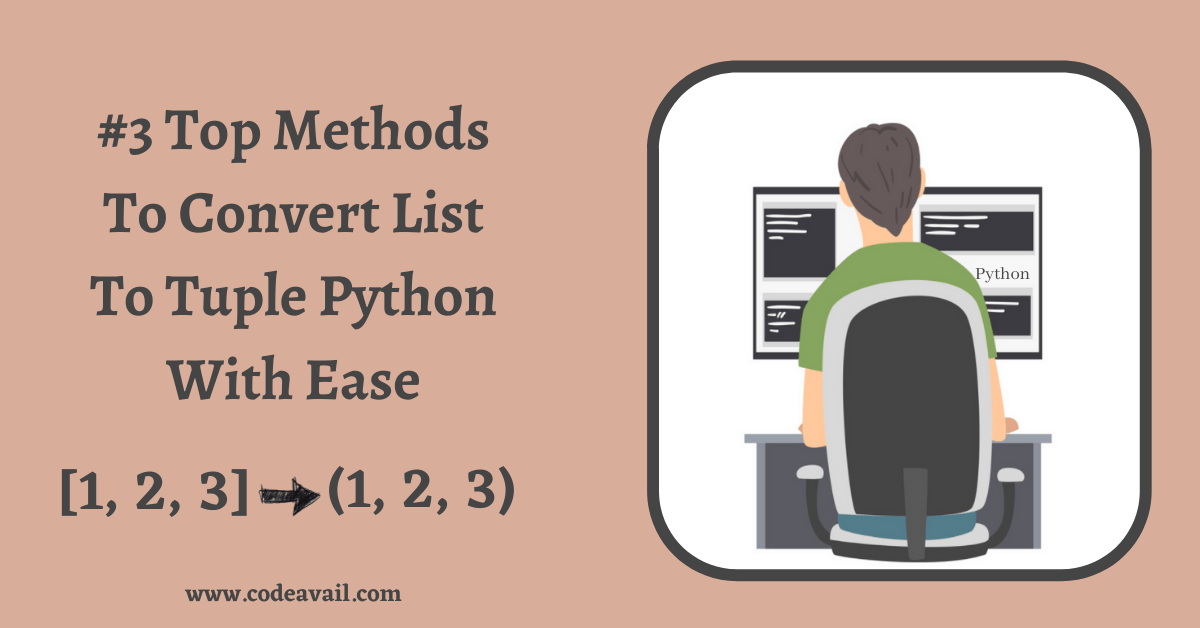
Python is ranked first among the top ten programming languages for 2021. And there are a number of programmers who enjoy using this programming language. It’s simply not just because it’s simple, but it also provides a variety of interesting approaches to work with. Python is an object-oriented language with a variety of data types.
And it’s self-evident that Python users occasionally need to employ a specific data type to complete a task. The ones that come to mind are list and tuple. However, if you have a list and wish to convert it to a tuple, this is the place to learn about it. Today, I’ll go through the top three techniques for converting a list to tuple Python.
Overview of List and Tuple in Python
List In Python
The sized array in Python is dynamically equivalent to the list. Furthermore, Python lists can contain a variety of components such as texts, numbers, and objects. As a result, the list can be sorted and changed.
The element in the list can be declared using square brackets [ ] separated by commas. You can use the index values to access the elements of the list and add and remove elements if needed.
Tuple in Python
It’s a data structure for holding a number of different elements in a single variable. It can also hold a variety of elements (just as the list). It can store a variety of data kinds, and the elements in the tuple cannot be easily added or removed.
To define the elements in a tuple, use parenthesis () and commas to divide them.
How to convert the list to tuple Python?
It should be self-evident that a Python coder must perform various operations on the data. And each operation has unique features that change depending on the operations conducted. Python users might need to convert data from one kind to another on occasion. Converting a list to a Python tuple is one of them. So, let’s check two distinct approaches.
We’ve already discussed that Python offers a variety of data types, with a tuple() being one of them. Here, the iterable is passed as an argument, and it is converted to a tuple object by this function.
If you need to convert a list to a tuple in Python, you’ll need to supply the entire list of elements as an input to the tuple() method. It will return a tuple data type as a result.

Output:
(‘dog’, 1, 2.55)
<type ‘tuple’>
You may call it a short variant of the previously discussed strategy. The loop inside the tuple() built-in method can be used by Python users. Apart from that, we’d say it’s the least-used technique for converting a list to a tuple in Python.

Output:
(‘dog’, 1, 2.55)
<type ‘tuple’>
When should you use tuples instead of lists in Python?
It is self-evident that it is dependent on the needs of the individual.
If there is no need to update the data, however, the tuple function is handy because it disables the change functionality. However, if the data shrinks or grows during the application’s runtime, use the list data type method instead.
So, choose one of these (list or tuple) and use it according to your needs and Python programme demands.
Final Words!
We hope this has clarified what a list and a tuple are, as well as how to convert a list to a tuple in Python. The methods are applicable on any IDE. Using the methods listed above, convert the list to a tuple if needed. However, keep in mind that the list is mutable, meaning that you can change the entries in the list by adding or removing them. The tuple is not modifiable at the same time.
Aside from that, you can ask us for extra information on any Python topics that you find difficult to grasp. I’ll assist you in quickly grasping Python ideas.
If you still have queries or concerns about Python topics, you can use the Python homework help to obtain guidance and enhance your grades and expertise. Get some more reasons to prefer professionals for Python homework help to obtain programming solutions.
It’s not as simple as selecting between a lightweight editor and a heavyweight IDE when it comes to Visual Studio vs Visual Studio Code. Visual Studio is a cross-platform integrated programming environment (IDE) that includes some of the most sophisticated tools for developing online and mobile applications. Visual Studio Code is an open-source and free code editor for Windows, macOS, and Linux.VSC is a code editor part of the Visual Studio package, and IntelliSense, debugging, Git integration, and other features are included. On the other hand, Visual Studio is more of an all-in-one tool for software development, including debugging, scripting, and diagnostics. Visual Studio Code includes all of the tools that developers need to work with JavaScript or TypeScript daily. It’s also capable of handling projects.
Let’s start with a definition of each word before diving into the distinctions between Visual Studio and Visual Studio Code.
Microsoft’s main IDE for macOS and Windows is the latest Visual Studio version. Visual Studio allows you to create, inspect, debug, test, assist, and utilize the software. On Windows, Visual Studio presently includes 17 workloads. Workloads are a significant improvement to the Visual Studio installation process, since a complete VS installation, specifically on an SSD, may take hours. Because it does not handle as many targets as the Windows version, the Visual Studio installation for Mac is simpler. It allows you to create for the web, desktop, mobile, and other platforms. Default has introduced support for.NET, Azure, Unity, and Docker.
It’s a small yet powerful source code editor that runs on your computer and is compatible with Linux, Windows, and macOS. It has a built-in JavaScript, Node.js, and TypeScript helper. It offers a large ecosystem of extensions for several languages and runtimes (C sharp, C++, Java, PHP, Python, and Go) (Unity and . Net). Procedures, variables, and imported plugins all provide IntelliSense code completion. It contains additional important editing tools, such as stylish code navigation and refactoring, in addition to the overall notion of being lightweight and beginning quickly. It comes with a built-in source code command that supports Git. The most of information was adapted from Visual Studio techno.
If you do not have an absolute understanding of both, choosing between Visual Studio Code and Visual Studio for every software development work is difficult. For some computer languages, Visual Studio Code may be customized to be very similar to an IDE. If your development technique is test-driven, Visual Studio, for example, will work right out of the box. Visual Studio Code, whereas, includes 15 test-driven development extensions for Node.js, Go,.Net, and PHP. Similarly, VS excels at dealing with databases, notably Microsoft SQL Server and its offshoots, despite the fact that Visual Studio Code comes with a number of database extensions.
Visual Studio Code only covers the essentials of a half-dozen languages, whereas Visual Studio includes strong refactoring tools. This rule is not without exceptions. If you’re a software developer, for example, and you have Visual Studio Enterprise, you should take advantage of it.
If you need to work on development or debugging with other members of the team, Visual Studio is the better option. From a snapshot, Visual Studio Enterprise can assist you with code analysis, performance profiling, and troubleshooting. In the data science community, VS Code is widely used.
As previously stated, Visual Studio is a cross-platform IDE (Integrated Development Environment) that includes some of the most sophisticated tools for developing online and mobile applications. Visual Studio Code is a free and open-source code editor for Windows, macOS, and Linux. When Google trends are compared, both Visual Studio and Visual Studio Code are in great demand. But, in this case, which is in great demand? The demand for both Visual Studio and Visual Studio Code has been equal in recent years.
To summarise, the main difference between Visual Studio and Visual Studio Code is that Visual Studio Code is for you if you merely want to create code quickly and efficiently. It’s small and light, so it just requires a few settings. You also have the choice of adding features as and when you require them. Visual Studio Code is one of the better solutions for languages that don’t require an IDE (Integrated Development Environment). Visual Studio, on the other hand, will be ideal if you are a skilled programmer that needs a lot of resources to construct a project.
Visual Studio retains all of the capabilities of Visual Studio Code.
We hope that the differences between Visual Studio and Visual Studio Code have been clarified; nevertheless, if you want further knowledge on any of these concepts, you may seek Visual Studio assignment help or Visual Studio code assignment help.

Python project learning can be difficult. You can spend your time watching videos or reading books, but the real struggle is actually to put what you have learned into practice. Or you might lose motivation because you have spent a lot of time learning the syntax of the programming. How can you improve your possibilities of achieving this?
By making the first Python projects. Creating Python projects will help you understand everything about what you are learning. Once you start making Python projects, you will feel like you are making progress. But it can be difficult for beginners to create their first python project. Different questions will come to your mind like from where will you start? What makes a good Python project?
In this article, we have included all the relevant pieces of information regarding the first Python project tips and different ideas for the first python project.
Create a program that randomly decides a number to choose; after that, you will have several possibilities to choose the number accurately. In every incorrect attempt, the computer will indicate that the number is higher or smaller than the one you have chosen.
import random
number=random.randrange(0,50)
guessCheck=”wrong”
print(“Thanks for coming to number guess”)
while guessCheck==”wrong”:
response=int(input(“Please give a number from 0 to 50:”))
The binary search algorithm is a very efficient method to seek for an element in a long list. The idea is to complete the algorithm that seeks for an element in an index.
| index : 0 1 2 3 4 5 6 7 t u t o r i a l |
The rolling a dice simulator will reflect the experience of dice rolling. It will create a casual number, and you can repeatedly play to get a number from the dice until you choose to quit the program.
The email slicer is an effective program to get the domain name and username from an email address. You can customize and convey a message to the user with this data.
A desktop notification application runs on your system and will be utilized to send you notifications after some time. You can utilize the libraries like requests, notify2, etc to make this application.
The project will randomly generate stories with a few customizations. You can ask users to include some words like name, action, etc, and then it will transform the stories with the help of your words.
Firstly, let’s see why learning based on the project method is so efficient.
First, making Python projects encourages you to learn more efficiently because you can pick a topic or project that fascinates you.
It encourages you to stay motivated when things get difficult at that time. It is essential for stopping you from giving up.
Another purpose of the best first python project is that there is no gap between getting new skills and putting them into practice. You will not spend time studying unnecessary things, because you will be continuously trying to get the particular things you require to create your project. This will also help you in reaching a lot faster where you want to go. For data science projects, you are trying to learn Python for building data science projects. For example, you are learning Python concepts that might be important for your robotics programming but not for your data science goals.
In this article, we have included all the helpful information regarding the Python project and why project-based learning is so important for you. We have also included some of the python project ideas that are beneficial for beginners which you can solve with ease. Creating Python projects will help you understand everything about what you are learning. Once you start making Python projects, you will feel like you are making progress. If you want to increase your python programming skills, you need to get some ideas for the first python project from this article and create my first python project.

Uses of MS Excel, there are many questions in the mind of users who do not know much about excel. And that is what we are here for Uses of Excel. In this blog, we will talk about Microsoft excel and we will know what it is. What are the top uses of Microsoft Excel, or its uses in businesses.? And many more things about excel.
Let’s start by knowing what excel exactly is:
So, it is a software program created by Microsoft in which there are spreadsheets to organize numbers. And data formulas or any type of functions which means you can organize any kind of data with the help of spreadsheets in Microsoft Excel. However, and now you must be thinking that’s why we have called it Microsoft Excel the program was developed by Microsoft.
Microsoft Excel organizes data in rows and columns and these rows and columns intersect at a pace called a cell. And using these you can organize any kind of data. Whether it is of personal use or it may be for any type of business.
Because a disorganized or not managed data is just garbage. Whether it may be for anyone, maybe for personal use or for any business. And you are unable to use it if it is not managed properly. And that data is surely taking so much space in your systems. So, data should always be managed properly and should be organized in the best way possible.
And that is what the excel for, it is for organizing any type of data. So that you can use that data later in your business or anything. Because we all know the importance of properly managed data. Data is called data only when it is properly organized and is useful for someone. And if not then it is just garbage.
So, the data should be always organized and we can get it organized with the help of excel and we can also call it Microsoft excel. So, now as you already know the basic function of excel is data management or organizing data. Now it’s time for you to know about the top uses of Microsoft excel and which is our topic for this blog.
So, there are many reasons for people to use Microsoft excel. And as you already know that the basic reason behind using excel is that you can manage and organize different types of data with the help of Excel.
For example, let’s suppose that someone is using excel for personal use and that can be anything like they can use it for managing their monthly expenses and other things like that. Or for business use, a company can use it for managing its data whether it may be of any type. So, there can be many things that can be done with the help of excel.
So, you already know what it is used for and why people use excel. Now it’s time for you to know about,
So, these were some of the uses of Excel and which was our topic for today. That is use of Microsoft Excel to share this with your friends and colleagues or home so ever you want to share it with to let them know about the top uses of MS Excel.

Here in this blog, you will learn 8 Best Steps on How to write an assignment report step by step in detail.
Reports for the most part include introducing your research and study of data or an issue, advising activities, and making plans and suggestions about it. That is what the reports of an assignment are for. And making reports is a bit of a difficult task for most of the students. And they always try to hide from it, which is not a good thing to do. Because writing a report for assignments is important. As only you have an idea about what you have written in your assignment for How to Write An Assignment Report. That is why you should write your own assignment report.
1: Decide on the “Terms and conditions of the reference’
2: Decide on the methodology
3: Find the relative data/ information
4: Decide the structure
5: Draft the initial segment of your report
6: Draft the table of contents
7: Arrange a reference list
8: Revise your draft
To settle on the terms of reference for your report, read your guidelines and some other data you’ve been given about the report, and consider the reason for the report:
This implies arranging your findings and what you have investigated or explored, and how you’ll compose the report. These are the thing which you should ask yourself so that you can decide the methodology for your assignments’ report:
Asking these inquiries in your mind will assist you in drafting the method section of your report, which plots the means you’ve taken to do the research or the assignment you have done.
The most important thing to do is to discover the data you require for your report. To do this you may need to scan several written materials, watch individuals or practices, or other things which may help you with your assignment work.
Ensure the data you find is appropriate and proper. Check your assignment’s requirements and rules and what is it asking from you. But if In case you don’t know how the information will be gathered for your assignment then you should contact your instructor.
Asking these inquiries in your mind will assist you in drafting the method section of your report, which plots the means you’ve taken to do the research or the assignment you have done.
So, this was all about how to write an assignment report. We hope that you have got some knowledge out of it. And now you will be able to work on your own and if not then we are here to help you with any kind of work. You can contact us anytime. Our Computer Science Assignment Help experts are available for you 24*7.
And if you like what you have read, then share this with your friends and let them know how to write an assignment report.
Here in this blog, you will learn 4 steps on how to create an assignment in google classroom step by step in detail.Google Classroom is a straightforward digital filing system given by Google that allows teachers to teach from the cloud by organizing classes, reacting to writing, checking file access, and the sky’s the limit from there for How To Create An Assignment In Google Classroom. We’ve provided ways in which teachers can use Google Classroom in the past. Below, we provide Google’s own how-to guidelines on making assignments in Google Classroom for the computer systems, Android, and iOS.
Of course, the assignment is expected the following day. To transform it:
You can include attachments, for example, Google Drive files, YouTube videos, or attachments to your assignment.
To attach an attachment, click Link, enter the URL, and click Add.
To remove an attachment, click Remove close to the attachment.
So, this was all about steps on How to create an assignment in google classroom. We hope that you have learned something from this blog. If so, then share this with your friends and let them know about How to create an assignment in google classroom.
As a result, Our computer science assignment help experts are available for you to 24*7. Submit your queries and requirements to get an instant solution.

 codeavail2